

Appraisers use comparable sales to support divorce property valuations in New Jersey by analyzing recent, arm's-length transactions of similar properties to establish a defensible market value. This independent data helps courts and attorneys divide assets fairly, ensuring the valuation is not biased toward either spouse's financial interests.
Why Comparable Sales Matter in Divorce
In New Jersey, equitable distribution requires an accurate valuation of marital assets. A comparable sale is a recent transaction of a similar property that serves as the primary evidence for determining market value. Without reliable comparables, a valuation is just an opinion, and opinions are easily challenged in court.
Divorce proceedings are adversarial. One spouse may argue the home is worth less to reduce their share of the equity, while the other argues it is worth more. A certified appraiser resolves this by relying on objective market data rather than subjective estimates. This neutrality is critical because the final number directly impacts the financial outcome for both parties.
New Jersey Real Estate Appraisal Group (NJREAG) emphasizes that the selection of comparables is the most scrutinized part of a divorce appraisal. If the data is weak, the entire report is vulnerable to cross-examination. Therefore, the focus is always on finding sales that truly reflect the subject property's characteristics.
Criteria for Selecting Valid Comparables
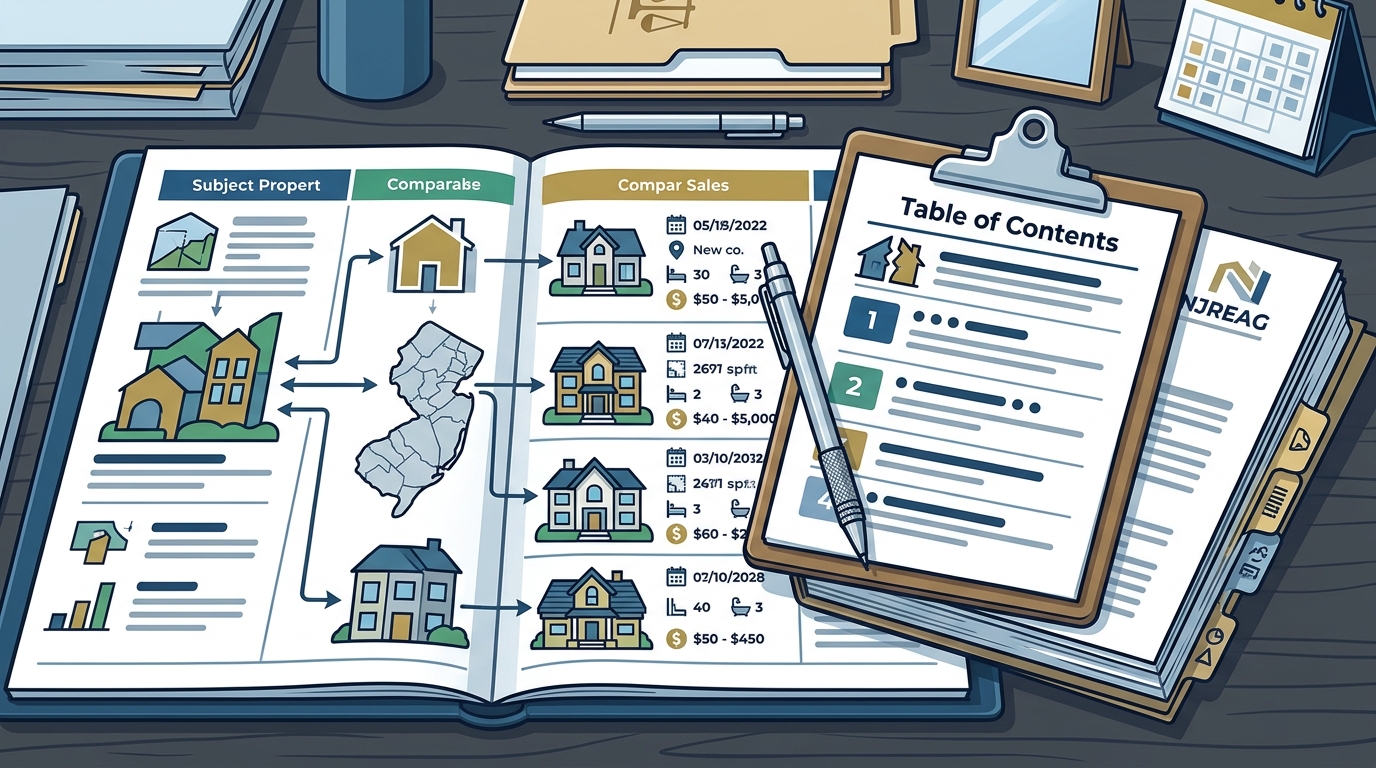
Not every recent sale is a valid comparable. An appraiser must filter out data that does not reflect true market conditions. A comparable property is a recently sold property that is similar to the subject property in location, size, age, and condition. The goal is to find sales that a typical buyer would consider interchangeable with the subject home.
Appraisers typically look for three to five comparable sales. These sales must be arm's-length transactions, meaning they were not between family members or entities with a special relationship. Foreclosures and short sales are often excluded or heavily adjusted because they do not represent normal market behavior. In New Jersey, where property values can vary significantly by school district and municipality, location is the most critical factor.
For example, in Bergen County, a home in Ridgewood may not be a valid comparable for a home in Alpine, even if they are the same size. The market dynamics, desirability, and price points are too different. NJREAG appraisers carefully map the market area to ensure comparables come from the same competitive set as the subject property.
The Adjustment Process
Rarely is a comparable property identical to the subject property. Therefore, the appraiser must make adjustments to the sale price of the comparable to reflect the differences. This process is known as the sales comparison approach, which is a method of valuation that adjusts the prices of comparable sales to estimate the value of the subject property.
Adjustments are made for physical characteristics, such as square footage, number of bedrooms, and garage size. They are also made for economic factors, such as the date of sale and market conditions. If a comparable sold six months ago and the market has risen by 2% since then, the appraiser will adjust the price upward. If the comparable has a renovated kitchen and the subject does not, the appraiser will adjust the price downward.
Ensuring Court-Ready Defensibility
In a divorce, the appraisal report may be challenged by the opposing attorney. The report must be written to withstand this scrutiny. A defensible appraisal is a report that clearly documents the methodology, data sources, and reasoning behind the value conclusion. It must be transparent enough for a non-expert to understand how the number was derived.
USPAP (Uniform Standards of Professional Appraisal Practice) compliance is mandatory. This means the appraiser must disclose all significant assumptions and limiting conditions. If a comparable was excluded, the report should explain why. If an adjustment was made, the report should show the data that supported it. This level of detail is what makes a report court-ready.
NJREAG prepares reports that are specifically designed for legal proceedings. We understand that judges and mediators need clear, concise, and well-supported documentation. Our reports include detailed analyses of the market, the property, and the adjustments, ensuring that the value conclusion is robust and credible.
Common Mistakes to Avoid
Homeowners and attorneys often make mistakes when trying to understand or influence the appraisal process. One common error is relying on online estimates like Zillow. These automated valuation models (AVMs) do not perform physical inspections or detailed comparable analysis. They are not accepted by New Jersey courts for divorce settlements.
Another mistake is assuming that the most recent sale is always the best comparable. If a home sold last week but was in poor condition or had a unique feature, it may be a poor comparable. The appraiser must use professional judgment to select the best data, not just the newest data. Finally, clients should not try to coach the appraiser on what the home is worth. The appraiser's role is to provide an independent opinion, not to advocate for a specific number.
By understanding how comparable sales are used, clients can better appreciate the value of a professional appraisal. It is a tool for fairness, not a weapon for negotiation. NJREAG provides independent, unbiased valuations that help both parties reach a fair settlement.
Key Takeaways
- Comparable sales are the primary evidence used to determine market value in divorce appraisals.
- Valid comparables must be arm's-length transactions of similar properties in the same market area.
- Appraisers adjust comparable prices for differences in physical characteristics and market conditions.
- The sales comparison approach is the most common method for valuing residential real estate in New Jersey.
- Court-ready reports must clearly document the selection and adjustment of comparables to withstand legal challenge.
- Online estimates are not accepted by New Jersey courts for divorce settlements.
- Independent appraisers provide neutral valuations that help ensure fair equitable distribution.
Frequently Asked Questions
How many comparable sales are needed for a divorce appraisal?
Appraisers typically use three to five comparable sales. The exact number depends on the availability of data in the local market and the complexity of the property.
Can I use a Zillow estimate for my divorce?
No. Zillow and other automated valuation models are not accepted by New Jersey courts for divorce settlements. You need a certified appraisal based on a physical inspection and detailed comparable analysis.
What if there are no recent sales in my neighborhood?
The appraiser may need to expand the search area to a broader market or use older sales with appropriate adjustments. They will document this process in the report to explain how the value was determined.
Do both spouses have to agree on the appraiser?
It is often best if both parties agree on a single appraiser to save time and money. However, each party can hire their own appraiser if they disagree on the value. Your attorney can advise you on the best approach for your case.
How long does a divorce appraisal take?
Most residential appraisals are completed within 5 to 10 business days after the inspection. Complex properties or those in areas with limited data may take longer.
Is the appraisal report confidential?
Yes. Appraisal reports are confidential documents. They are shared only with the intended users, such as the attorneys, mediators, and court, as specified in the assignment.
Conclusion
Accurate property valuation is essential for a fair divorce settlement in New Jersey. By using comparable sales, appraisers provide an objective, defensible opinion of market value that stands up to legal scrutiny. New Jersey Real Estate Appraisal Group (NJREAG) specializes in divorce appraisals, offering certified, USPAP-compliant reports that support equitable distribution. To discuss your specific situation, for a confidential consultation.