

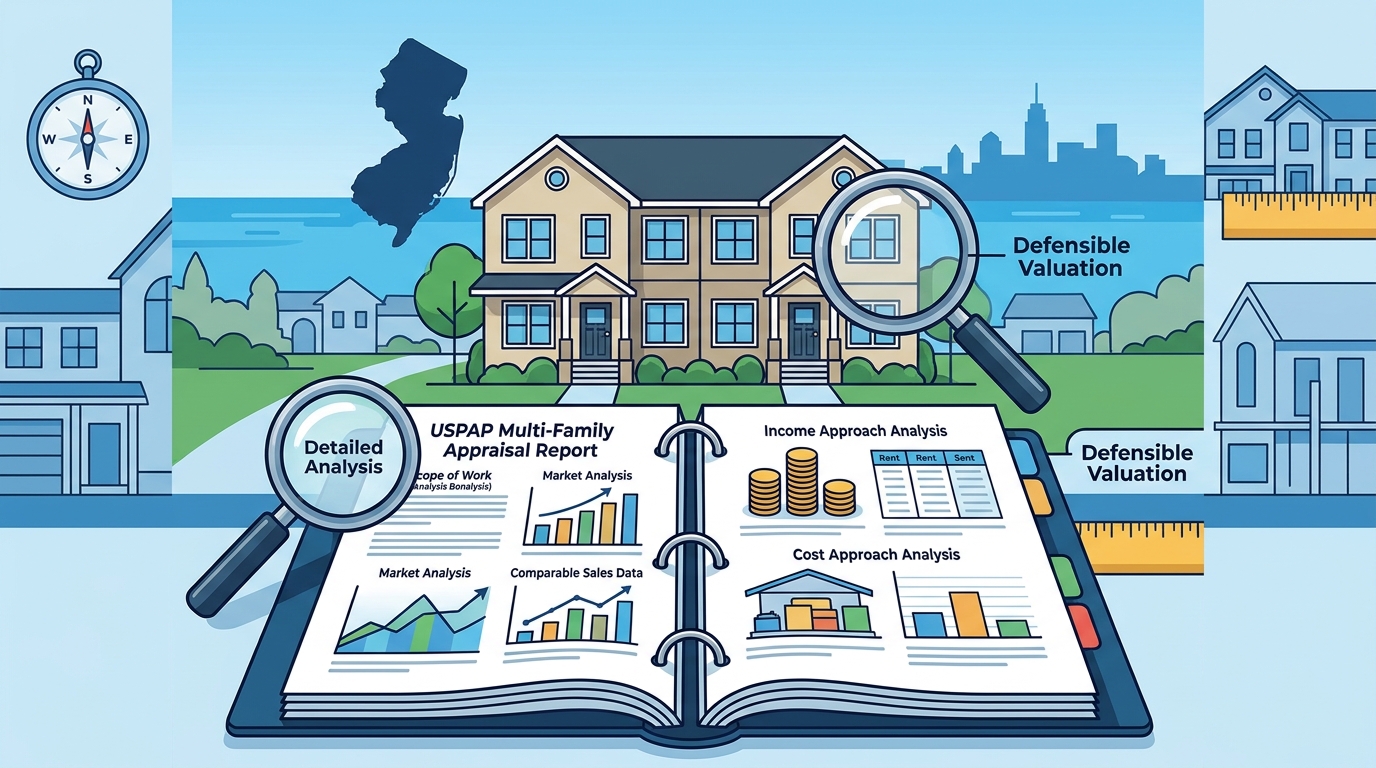
A USPAP-compliant multi-family appraisal report is a formal document that provides a defensible opinion of value for properties with two to four units. It must include specific disclosures, a clear scope of work, and detailed analysis of rental income and physical condition. For New Jersey property owners, understanding this structure ensures the report meets legal and lending standards. New Jersey Real Estate Appraisal Group prepares these reports to withstand scrutiny from lenders, courts, and tax authorities.
Core Requirements for Multi-Family Reports
Uniform Standards of Professional Appraisal Practice (USPAP) is the national body of standards that governs the practice of real estate appraisal in the United States. For multi-family properties, the report must clearly identify the property rights being appraised, such as fee simple or leasehold interests. The appraiser must also disclose any special assumptions or hypothetical conditions that affect the value conclusion. This transparency is critical because multi-family assets often involve complex ownership structures or pending leases that influence marketability.
The report must state the effective date of the appraisal, which is the specific date as of which the value opinion is made. In New Jersey, this date often aligns with the date of death for estate cases or the current date for lending transactions. The appraiser must also identify the intended users of the report, such as a specific bank or a court. This identification prevents the report from being misused by parties who were not considered during the valuation process.
The Income Approach and Rental Analysis
The income approach is a valuation method that estimates property value based on the income it generates. For multi-family properties, this approach is often the most reliable indicator of value because investors purchase these assets primarily for their cash flow. The report must include a detailed operating statement that lists gross potential income, vacancy and collection loss, and operating expenses. Each line item must be supported by market data or verified lease documents.
Appraisers must also calculate the capitalization rate, which is the ratio of net operating income to property value. This rate reflects the risk and return expectations of the local market. In New Jersey, capitalization rates vary significantly by submarket, from urban centers like Newark to suburban areas like Princeton. A credible report will explain how the selected capitalization rate was derived, using evidence from recent sales of similar income-producing properties. This analysis provides the lender or court with a clear understanding of the property's income potential.
Physical Description and Condition Assessment
The physical description section of the report is a detailed account of the property's characteristics, including site, improvements, and condition. For multi-family properties, the appraiser must describe each unit individually, noting the number of bedrooms, bathrooms, square footage, and any unique features. The report must also include a condition rating for the overall property and each unit, typically using a scale from excellent to poor. This assessment is supported by dated photographs and a narrative description of any deferred maintenance or code violations.
In New Jersey, physical condition is particularly important for properties in older neighborhoods where renovation needs can significantly impact value. The appraiser must distinguish between cosmetic issues and structural problems, as the latter can affect the property's insurability and financing. A thorough physical description helps the reader understand the true state of the asset, preventing surprises during due diligence or legal proceedings.
Market Analysis and Comparable Sales
The market analysis section is an evaluation of the local real estate market that supports the value conclusion. It must include a description of the neighborhood, its demographics, and recent trends in supply and demand. For multi-family properties, the appraiser must also analyze the rental market, including average rents, vacancy rates, and absorption rates. This analysis provides context for the income approach and helps explain why the property is valued at a certain level.
The report must also include a sales comparison approach, which is a valuation method that estimates value by comparing the subject property to similar properties that have recently sold. The appraiser must select at least three comparable sales, adjusting for differences in location, condition, and income potential. Each adjustment must be supported by market evidence, such as paired sales analysis or expert opinion. This rigorous process ensures that the final value is grounded in actual market transactions, not speculation.
Legal Compliance and Defensibility
Legal compliance is a critical aspect of any appraisal report, especially when used in court or for tax purposes. The report must comply with all applicable laws and regulations, including the Financial Institutions Reform, Recovery, and Enforcement Act (FIRREA) for federally related transactions. In New Jersey, appraisers must also adhere to state-specific requirements, such as those set by the New Jersey Real Estate Appraiser Board. This includes maintaining proper licensing and completing required continuing education.
A defensible report is one that can withstand challenge from opposing parties in a legal proceeding. This requires clear documentation of the appraiser's methodology, data sources, and reasoning. The report must be free from bias or advocacy, presenting an objective opinion of value. Divorce appraisals and estate appraisals in New Jersey often require this level of defensibility, as the value conclusion can have significant financial and legal consequences for the parties involved.
Key Takeaways
- USPAP compliance requires clear disclosure of property rights, effective date, and intended users.
- The income approach is essential for multi-family properties, requiring detailed operating statements and capitalization rate analysis.
- Physical descriptions must include unit-by-unit details and condition ratings supported by photographs.
- Market analysis must cover both sales and rental trends to provide context for the value conclusion.
- Legal compliance ensures the report meets federal and state standards, enhancing its defensibility in court.
- Working with a state-certified appraiser ensures the report adheres to all applicable regulations.
Frequently Asked Questions
What is the difference between a residential and multi-family appraisal?
A multi-family appraisal includes detailed income analysis and unit-by-unit descriptions, while a residential appraisal focuses primarily on physical characteristics and comparable sales. Multi-family properties are valued based on their income potential, making the income approach a critical component of the report.
How many comparable sales are required for a multi-family appraisal?
USPAP does not specify a minimum number of comparable sales, but best practice is to use at least three. The appraiser must select comparables that are similar in location, size, and income potential, and adjust for any differences.
Can I use an online estimate for a multi-family property?
No, online estimates are not USPAP-compliant and are not accepted by lenders, courts, or tax authorities. A formal appraisal by a state-certified appraiser is required for legal and financial purposes.
How long does it take to complete a multi-family appraisal?
The timeline depends on the complexity of the property and the availability of data, but most multi-family appraisals are completed within 5 to 10 business days. Rush services may be available for an additional fee.
Who can order a multi-family appraisal in New Jersey?
Any party with a legitimate interest in the property can order an appraisal, including homeowners, lenders, attorneys, and tax authorities. The appraiser must identify the intended users in the report to ensure proper use.
Conclusion
A USPAP-compliant multi-family appraisal report is a comprehensive document that provides a defensible opinion of value based on rigorous analysis of income, physical condition, and market trends. Understanding the structure and requirements of these reports helps property owners and professionals make informed decisions. Contact New Jersey Real Estate Appraisal Group to schedule a certified appraisal for your multi-family property in New Jersey. Learn more: Contact NJREAG Certified Appraisers.