
Choosing the Right Comparable Sales for Your NJ Property Tax Appeal
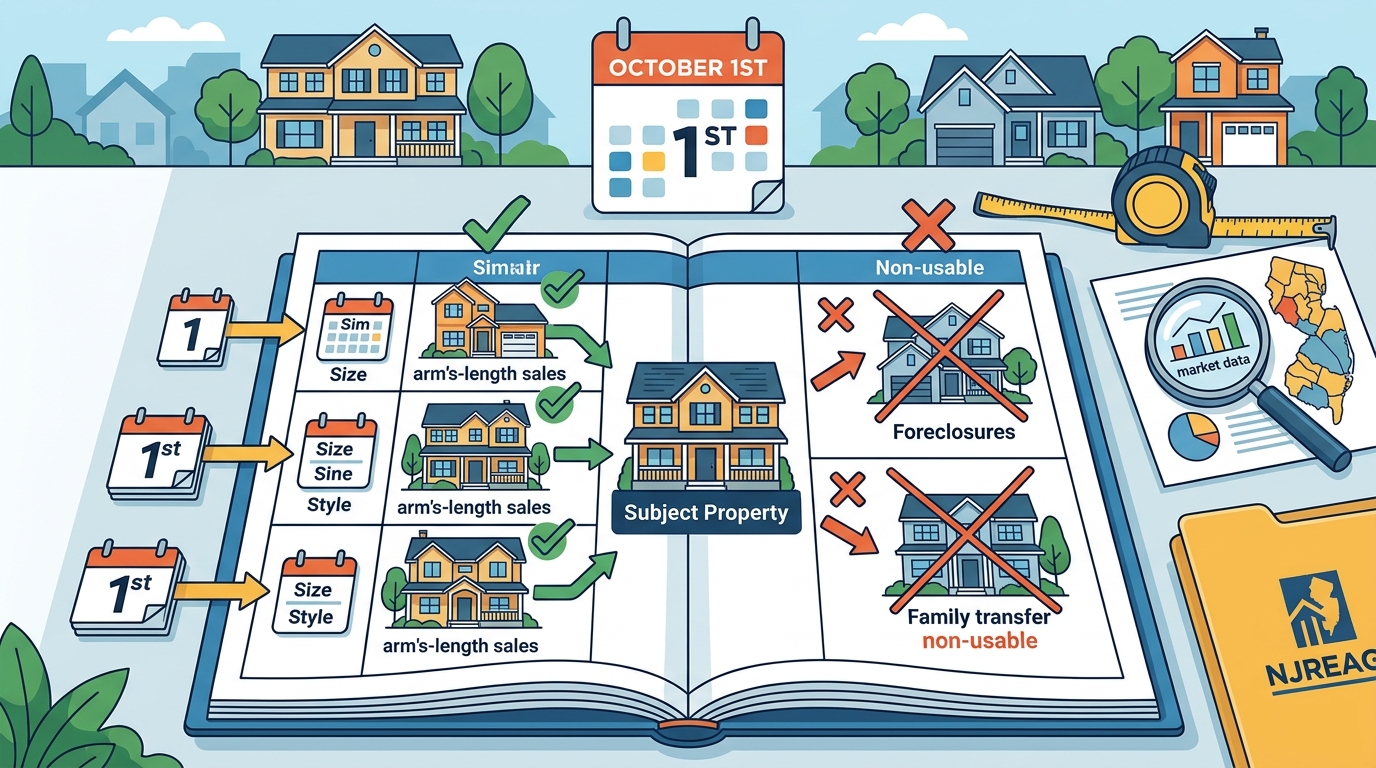
Use three to five arm's-length comparable sales that closed near the October 1 assessment date and match your property's size, style, and location. New Jersey Real Estate Appraisal Group (NJREAG) advises homeowners to avoid non-usable sales like foreclosures or family transfers, as these carry little weight in county tax board hearings. Properly selected evidence is the primary driver of successful assessment reductions.
The Legal Standard for Comparables
Comparable sales data is the primary evidence used to establish the market value of a property in a New Jersey tax appeal. The legal standard requires that these sales be "arm's-length," meaning they occurred between unrelated parties for fair market consideration. County tax boards across the state, including the Essex County Tax Board, explicitly reject non-usable sales such as foreclosures, short sales, and estate or trust transfers. These transactions often reflect distress or specific legal circumstances rather than true market conditions, making them unreliable for valuation purposes. according to Where Do People
Furthermore, the assessment is presumed correct, placing the burden of proof on the property owner. This means your comparable sales must be strong enough to overcome the presumption that the current assessment is accurate. In many counties, the board will only consider sales that occurred within a specific window, typically the 12 months preceding the October 1 assessment date. If you rely on sales that are too old or too new, the board may dismiss them as irrelevant to the valuation date.
Matching Property Characteristics
A valid comparable must closely match the subject property in physical and locational characteristics. The most critical factors include living area, lot size, age, and style. For example, a two-story colonial should be compared to other two-story colonials, not to a rancher or a townhouse. In rural areas like Hunterdon County, land use and acreage often matter as much as the house itself. A home on a subdividable lot is a different market segment than a home on a non-subdividable lot, and mixing these in your evidence can weaken your case.
Proximity is also a key factor. While the exact distance varies by county, comparables should generally be in the same neighborhood or a very similar one. A sale in a high-end subdivision may not be a valid comparable for a home in a standard suburban block, even if the square footage is identical. The goal is to find sales that a typical buyer would consider when deciding whether to purchase your property. If the comparables are too dissimilar, the board may apply large adjustments that reduce the credibility of your valuation.
The Importance of Timing
Timing is one of the most common reasons tax appeals fail. In New Jersey, the value of a property is set as of October 1 of the pre-tax year. This is known as the assessment date. For a 2027 tax appeal, the relevant date is October 1, 2026. Your comparable sales should ideally fall within the 12 months before this date. Sales that occur after the assessment date can support your conclusion, but they cannot serve as the primary evidence. This rule is consistent across counties, including Gloucester County, where the board requires sales to be close to the October 1 date.
If you cannot find enough sales within the 12-month window, you may use older sales, but you must be prepared to justify why they are still relevant. Market conditions can change rapidly, and a sale from two years ago may not reflect current values. The board will look for a trend in the market, and if your older sales do not align with recent trends, they may be discounted. This is why it is important to gather your evidence early and ensure that your comparables are as close to the assessment date as possible.
Avoiding Common Evidence Traps
One of the biggest mistakes homeowners make is using assessments of neighboring properties as evidence. County tax boards, such as the Cumberland County Board of Taxation, explicitly state that neighboring assessments are "unacceptable as evidence of value." Assessments are not sales, and they do not reflect what a buyer is willing to pay. They are merely the county's estimate of value, and using them in your appeal is like using the defendant's word against them in a court of law. It is not admissible evidence.
Another common trap is relying on automated valuation models (AVMs) or online estimates. These tools use algorithms and public data, but they do not account for the specific condition, location, or unique features of your property. Courts and tax boards do not accept AVMs as evidence of market value. Only a professional appraisal, based on a physical inspection and verified comparable sales, is considered credible. If you want to challenge your assessment, you need to provide evidence that meets the professional standards of the appraisal industry.
How an Appraiser Helps
A state-certified appraiser brings the expertise needed to select the right comparables and present them in a defensible format. At New Jersey Real Estate Appraisal Group, we prepare tax appeal appraisals that are designed to hold up in front of a county tax board. Our reports include a detailed analysis of the market, a selection of the best three to five comparable sales, and a clear explanation of how we arrived at the final value. We also ensure that the evidence is formatted according to the specific requirements of your county's tax board.
Using a professional appraisal also ensures that the appraiser is available to testify at the hearing. In many counties, if you submit an appraisal, the appraiser must be present to answer questions from the board. This is a critical requirement that many homeowners overlook. If you are not prepared to testify, or if your evidence is not in the correct format, your appeal may be dismissed. A professional appraisal gives you the best chance of success by ensuring that your evidence is both credible and compliant.
Key Takeaways
- Use three to five arm's-length comparable sales that closed near the October 1 assessment date.
- Avoid non-usable sales such as foreclosures, short sales, and family transfers.
- Ensure comparables match your property in size, style, age, and location.
- Do not use assessments of neighboring properties as evidence of value.
- Automated valuation models and online estimates are not accepted by tax boards.
- A professional appraisal ensures your evidence is formatted correctly and the appraiser can testify.
Frequently Asked Questions
How many comparable sales should I use for a tax appeal?
Most New Jersey county tax boards require three to five comparable sales. Using more than five can dilute your evidence, and using fewer than three may not provide enough support for your valuation. The key is to select the best three to five sales that most closely match your property.
Can I use sales that happened after the October 1 assessment date?
Sales that occur after the assessment date can support your conclusion, but they cannot serve as the primary evidence. The board will look for sales that are close to the October 1 date, so it is best to focus on sales that occurred in the 12 months before that date.
Why can't I use my neighbor's assessment as evidence?
Assessments are not sales, and they do not reflect what a buyer is willing to pay. County tax boards explicitly state that neighboring assessments are not acceptable as evidence of value. You must use actual sales data to support your appeal.
Do I need a professional appraisal for a tax appeal?
While you can file an appeal without an appraisal, a professional appraisal significantly increases your chances of success. It ensures that your evidence is credible, formatted correctly, and that the appraiser is available to testify at the hearing.
What if I can't find enough comparable sales in my neighborhood?
If you cannot find enough sales in your immediate neighborhood, you may use sales from a similar neighborhood. The key is to ensure that the comparables are as similar as possible in terms of size, style, and location. A professional appraiser can help you identify the best comparables when local sales are limited.
Conclusion
Choosing the right comparable sales is the foundation of a successful property tax appeal in New Jersey. By focusing on arm's-length sales that match your property's characteristics and timing, you can build a strong case for a lower assessment. If you are unsure about the best evidence to use, contact New Jersey Real Estate Appraisal Group for a professional appraisal that is designed to hold up in front of a county tax board.