

How Appraisers Find and Use Comparable Sales to Defend Valuations in Court
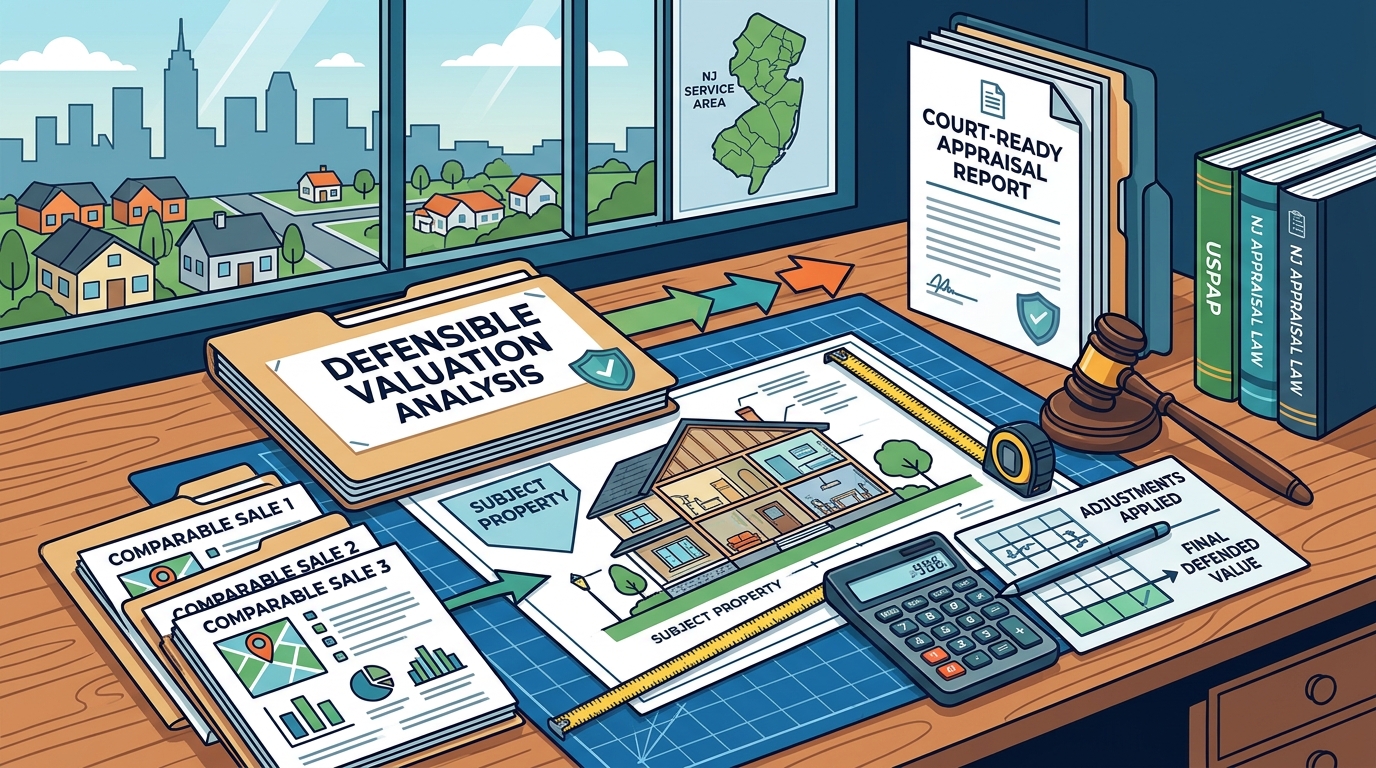
Appraisers defend valuations in court by selecting arm's-length comparable sales that closely match the subject property in location, size, condition, and sale date. They adjust these sales for differences to derive a defensible market value opinion. This evidence-based approach ensures the appraisal withstands cross-examination and meets professional standards. according to Chapter 2 Appraisal
Selection Criteria for Comparable Sales
A comparable sale is a recent, arm's-length transaction of a similar property used to estimate market value. In New Jersey, appraisers prioritize sales within the same neighborhood or municipality to ensure locational relevance. The selection process begins with identifying properties that share key characteristics with the subject, such as square footage, lot size, and architectural style. according to Chapter 2 Appraisal
For example, when appraising a two-family home in Essex County, an appraiser will look for other two-family homes in the same town or nearby areas with similar construction dates. This specificity is crucial because property values can vary significantly even within a single county. The appraiser must demonstrate that the selected sales are the most relevant available, which forms the foundation of the valuation opinion.
Adjustment Methodology and Data Sources
Once comparable sales are identified, the appraiser applies adjustments to account for differences between the subject property and the comparables. These adjustments typically cover location, physical characteristics, and market conditions. The goal is to bring each comparable sale to the estimated value of the subject property as of the effective date.
Appraisers rely on verified data sources, including county deed records, Multiple Listing Service (MLS) data, and public tax records. In New Jersey, the valuation date is often October 1 of the pre-tax year for tax appeals, or the date of death for estate appraisals. Using sales that fall within a reasonable time frame of this date strengthens the credibility of the analysis. For instance, if a property is being appraised for a 2027 tax appeal, the appraiser will focus on sales from late 2025 through late 2026.
Defending the Analysis in Courtroom Proceedings
In court, the appraiser must explain the rationale behind each comparable selection and adjustment. This involves presenting a clear, logical narrative that connects the market evidence to the final value conclusion. The appraiser may be required to testify and undergo cross-examination by opposing counsel.
For example, if an opposing party argues that a comparable sale is too far away, the appraiser must provide market data showing that the area is a single, cohesive market. This defense relies on the appraiser's local market knowledge and the ability to articulate why the selected sales are appropriate. A well-documented report with transparent adjustments makes it easier for the appraiser to defend the value under pressure.
Common Pitfalls That Weaken Appraisal Evidence
One of the most common reasons appraisals fail in court is the use of non-arm's-length sales, such as family transfers or estate sales. These transactions do not reflect true market value and can undermine the entire analysis. Appraisers must carefully screen for these types of sales and exclude them from the primary evidence.
Another pitfall is relying on outdated sales. If the market has changed significantly since the comparable sale, the appraiser must apply market condition adjustments or select more recent sales. Failing to account for market trends can lead to an inaccurate value opinion that is easily challenged in court. New Jersey Real Estate Appraisal Group emphasizes the importance of using current, verified data to ensure the appraisal holds up to scrutiny.
Key Takeaways
- Comparable sales must be arm's-length, recent, and similar to the subject property in location and characteristics.
- Adjustments for location, physical differences, and market conditions are essential to derive a defensible value.
- Verified data sources, such as county records and MLS data, provide the foundation for credible evidence.
- The appraiser must be prepared to explain the rationale behind each selection and adjustment in court.
- Non-arm's-length sales and outdated data are common pitfalls that can weaken an appraisal.
- Local market knowledge is critical for selecting the most relevant comparables in New Jersey.
Frequently Asked Questions
What makes a comparable sale valid for court?
A valid comparable sale is an arm's-length transaction that is recent and similar to the subject property in location, size, and condition. It must be supported by verified data and adjusted for any differences.
How many comparable sales are needed for a court-ready appraisal?
Typically, three to five comparable sales are used. The exact number depends on the availability of relevant data and the complexity of the property.
Can an appraiser use online estimates as comparables?
No, online estimates like Zestimates are not accepted as evidence in court. Appraisers must use actual, verified sales data from public records or MLS systems.
What if the market has changed since the comparable sale?
The appraiser must apply market condition adjustments to account for changes in the market. If the market has changed significantly, the appraiser may need to select more recent sales.
Do I need to be present at the hearing if I use an appraisal?
If you rely on a written appraisal, the appraiser must be present at the hearing to testify and be cross-examined. This is a requirement in many New Jersey counties.